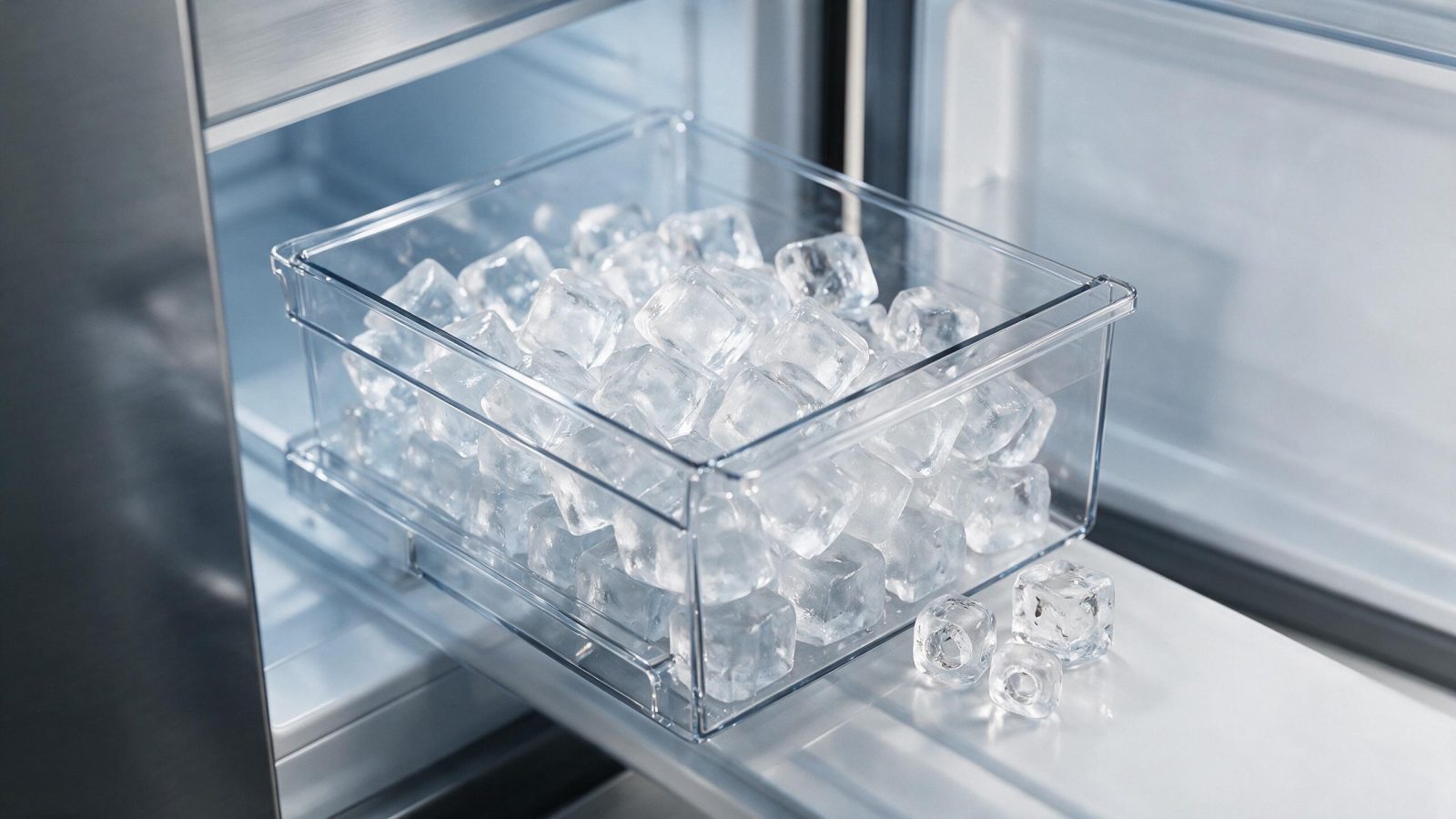
Small or hollow cubes can indicate that the ice mold is not filling with the expected amount of water, which directs attention to supply flow, filtration, freezing conditions, or the fill system. This guide explains safe checks, diagnostic clues, and the po...
Small or hollow cubes usually mean the ice mold is not getting enough water, so look at the supply valve, supply tubing, water filter and freezer temperature first. If flow checks out and cubes stay small, book a diagnosis of the fill system.
Small or hollow cubes can indicate that the ice mold is not filling with the expected amount of water, which directs attention to supply flow, filtration, freezing conditions, or the fill system. In practice, the model number and repeatable symptom pattern are more valuable than a broad internet parts list.
This guide focuses on KitchenAid ice maker small hollow cubes. If the appliance shows a specific diagnostic code, keep the code definition on the dedicated KitchenAid error-code pages and use this article for the operating context around that code.
The following steps are intentionally limited to non-invasive checks:
After an obvious external condition is corrected, use only the restart or acknowledgement procedure documented for the exact model. If the problem returns, stop repeating resets and preserve the evidence.
The mold is probably not filling with enough water. Supply flow, filtration, freezing conditions or the fill system are the branches to separate.
Instead of jumping to one failed component, work through the following source-consistent possibilities:
These are diagnostic branches, not instructions to replace every item named above. The exact model and the appliance’s behavior determine which branch is plausible.
| What you notice | What it can point to | What you can safely check |
|---|---|---|
| Cubes smaller than before | Low water flow or a clogged filter | Check the filter status and valve |
| Hollow shells that break | Insufficient fill or air in lines | Note whether dispenser flow is also slow |
| Slower production | Freezer temperature or restricted supply | Compare freezer temperature to your manual |
| Problem began after a move | Pinched water line behind the unit | Check the fridge is not pushed too far back |
Suppose you notice cubes are consistently smaller than before. Then compare that with ice shells are hollow or break easily. If both happen together, the diagnostic picture is different from a one-time event after unusual use. Write down the sequence before changing settings or resetting power; the order of events can help reproduce the condition.
The goal of a homeowner check for KitchenAid ice maker small hollow cubes is not to finish every diagnosis. It is to identify an obvious external condition, preserve useful evidence, and recognize when the next step requires protected service access.
When the appliance keeps repeating the same behavior, deeper diagnosis becomes more efficient than more trial-and-error.
Diagnosis may include actual water flow, filter housing, inlet valves, fill timing/command, ice-maker operation, freezer temperature, and model-specific sensors.
A diagnosis should confirm the affected system before a part is ordered. The display, sound, temperature, flame, water behavior, or cycle timing is evidence—not a parts invoice.
One KitchenAid support page describes a filter test: remove the filter and dispense water. If water flows well without it, the filter was probably installed incorrectly or is restricted. The page also advises against pushing the refrigerator back so far that the water line pinches.
That same troubleshooting content gives a replacement interval of about every six months or when the filter light comes on. A passing flow test does not clear the fill valve, and a failing one does not prove the filter is at fault, which is why a diagnosis should follow if the symptom continues.
KitchenAid has used multiple platforms across refrigerators, dishwashers, ovens, ranges, cooktops, microwaves and specialty kitchen appliances. Two appliances can look similar while using different sensors, controls, component layouts or diagnostic maps.
Use the complete rating-label model number, including the suffix where present. Do not pull a heavy built-in appliance out of cabinetry or remove a protected panel just to find the label; use the owner’s documentation to locate the normal accessible rating-label position.
A model number is especially important when a code appears. It prevents a definition from another appliance family or control generation from being applied to the wrong machine.
Do not remove powered ice-maker assemblies or access internal wiring. Stop if water is leaking into electrical areas.
General stop conditions also apply: smoke, visible arcing, burning-electrical odor, persistent gas odor, repeated breaker trips, uncontrolled heating, active water reaching electrical parts, a damaged microwave door/interlock, or a mechanism that can move unexpectedly.
Do not open live electrical compartments, adjust gas piping or regulators, bypass safety switches, access microwave high-voltage systems, or open a sealed refrigeration circuit as a homeowner troubleshooting step.
A concise service request can save diagnostic time:
If the condition remains unresolved, request repair and include the exact model plus the timing and behavior described in this guide.
No. Some causes are owner-accessible conditions, settings, loading, maintenance, installation, or normal operating behavior. The concern becomes more service-oriented when the pattern is repeatable after safe external checks.
The most useful clue is usually the repeatable pattern: cubes are consistently smaller than before. Pair that observation with the full model number and any code or recent change.
Yes when the pattern is repeatable, affects performance, or is becoming more frequent. Record the conditions that trigger it; intermittent behavior can be valuable diagnostic evidence.
Not without diagnosis. A control can report a problem created by a sensor, switch, load, wiring, utility condition, or another module.
Support content says about every six months or when the filter light comes on. Your manual gives the interval and reset steps for your model.
It can, if the water line pinches behind the unit and restricts flow. Pull the refrigerator out only as far as is safe and check the visible tubing.
Weak capture can come from dirty filters, blocked or restricted ducting, improper damper movement, installation limitations, blower problems, or using a speed that does…
A warming drawer that heats briefly or never maintains useful warmth can be affected by settings, loading, door closure, the heating system, sensor/control input,…
A compactor that stops with the ram in motion can involve an overloaded or jammed load, drawer/drive conditions, switches, motor/drive components, or control/power issues;…
Share a few details and we’ll confirm an appointment. Prefer to talk? Call us and we’ll help right away.
Use the secure scheduler below to request your appointment.